
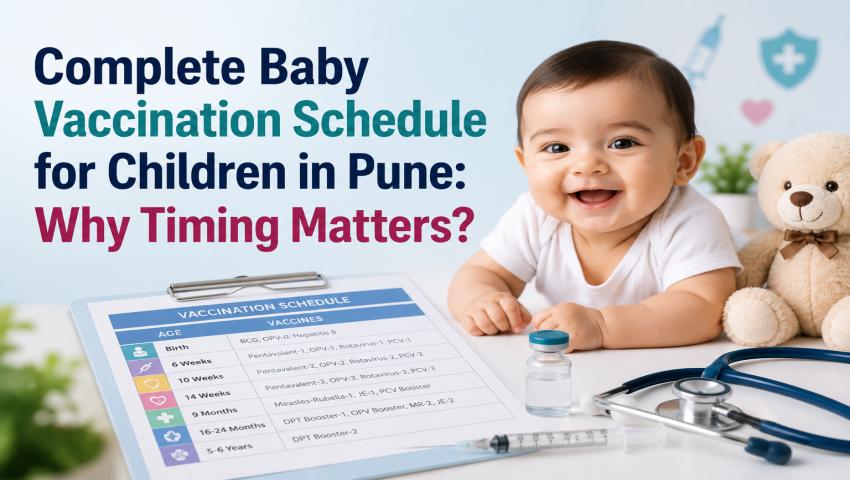
Every parent gets that little card at the hospital — the immunisation record — and suddenly it feels like there’s a lot to keep track of. Fourteen vaccines, dozens of doses, and dates that start from the day your baby is born. Dr Rachika Sujanyal, a paediatrician based in Pimpri, Pune, often tells parents: the schedule is not arbitrary. Every date on that card has a reason behind it.
This guide walks you through the full baby vaccination schedule — from birth to five years — in simple language. We’ll cover what each vaccine does, how the government and private schedules differ, what to do if you’ve missed a dose, and how to manage side effects at home.
What Is an Immunisation Schedule and Why Does It Exist?
An immunisation schedule is a timed plan that tells you which vaccines to give, and when. In India, two bodies set these guidelines: the World Health Organisation (WHO) and the Indian Academy of Paediatrics (IAP). The government runs its own version called the Universal Immunisation Programme (UIP).
Timing matters because a baby’s immune system is still developing. Some vaccines only work after a certain age — for example, the MMR vaccine is not given before nine months because maternal antibodies in the baby’s blood can block the immune response before that. Waiting too long, on the other hand, leaves the child unprotected during the most vulnerable window.
Think of the schedule as a biological clock. Miss the window, and you don’t necessarily start over, but catching up takes planning.
IAP vs Government (UIP) Vaccination Schedule:
Parents in Pimpri Saudagar and across Pune often ask: if the government gives free vaccines, why do private clinics recommend more? The honest answer is that the IAP schedule includes additional vaccines that protect against diseases the UIP doesn’t currently cover — like chickenpox, Hepatitis A, and some strains of meningitis.
Here’s a structured comparison to help you understand what’s available where:
Note: PHCs and government hospitals in Pune and PCMC area provide UIP vaccines at no cost. For IAP-recommended extras, parents can visit a child vaccination centre in Pimpri or Pimple Saudagar for private vaccination options.
Vaccine-by-Vaccine Guide — What Each Shot Actually Does?
- BCG — Protection Against Tuberculosis from Day One: BCG is given within 24 hours of birth, ideally before the baby leaves the hospital. It protects against severe forms of tuberculosis in young children, particularly TB meningitis. A small blister or scar at the injection site is normal and expected — it’s a sign the vaccine has worked.
- Oral Polio Vaccine (OPV) and IPV — What’s the Difference? : OPV is the oral drop version — easy to give and effective at gut-level immunity. IPV is the injected form and produces stronger blood immunity. The IAP recommends using both, because together they offer more complete protection. India is polio-free, and keeping it that way depends on high vaccination rates.
- Hepatitis B — Given at Birth for a Reason: The first dose of Hepatitis B is given at birth because transmission can happen during delivery. Hepatitis B is a liver infection that can become chronic if contracted in infancy, leading to serious liver disease in adulthood. Three doses are needed for full protection.
- DPT and DTaP — Standard vs Painless Vaccine: DPT protects against diphtheria, pertussis (whooping cough), and tetanus. The standard version causes more soreness and low-grade fever. DTaP is the ‘painless’ version — acellular, with fewer side effects, though slightly less immune-stimulating. Both are effective. The choice often comes down to parent preference and your paediatrician’s recommendation.
- Hib — Preventing Meningitis in Infants: Haemophilus influenzae type b (Hib) is a bacterium that can cause meningitis, pneumonia, and epiglottitis in children under five. Since Hib is included in combination vaccines (Pentavalent or Hexavalent), it doesn’t require a separate injection.
- PCV — Pneumococcal Protection: PCV guards against Streptococcus pneumoniae, a leading cause of bacterial meningitis and pneumonia in young children. Three doses plus a booster are recommended before 15 months. It’s not part of the standard UIP in most parts of Pune, so parents often opt for it privately.
- Rotavirus — The Anti-Diarrhea Vaccine: Rotavirus is the most common cause of severe diarrhoea and dehydration in babies under two. The vaccine is given as oral drops at 6, 10, and 14 weeks. It doesn’t prevent all diarrhoea, but significantly reduces hospitalisations.
- MMR vs MR — What Parents in Pune Should Know: MR protects against measles and rubella. MMR adds mumps to that protection. Government centres in Pune often stock MR; private clinics offer MMR. Two doses of MMR — at 9 months and 15 months — are recommended for full coverage. A third dose is sometimes given before school entry.
- Typhoid Conjugate Vaccine (TCV), Hepatitis A, Varicella, Influenza, Meningococcal: These are IAP-recommended vaccines not included in the government schedule. Typhoid (TCV) is given from nine months, especially in urban areas like Pimpri and Pimple Saudagar where food hygiene can vary. Hepatitis A is given at 12 and 18 months. Varicella (chickenpox) at 15 months and again before school. Influenza is recommended annually from six months onward.
For a full consultation on which vaccines suit your child, consider a paediatric consultation at a reputed child health clinic in Pune.
Age-Wise Vaccination Chart — 0 to 5 Years:
Use this as your quick reference. Carry it to every doctor’s visit and match it against your child’s immunisation card.
Families in Pimple Saudagar and across Pune can get help tracking this schedule by seeing a best paediatrician in PCMC who can maintain records and send reminders for upcoming doses.
Vaccination in Pune — Government Centres vs Private Clinics:
What's Free at PHCs in the PCMC Area?
Government Primary Health Centres (PHCs) across PCMC — including areas like Pimpri and surrounding localities — offer all UIP vaccines at no cost. These include BCG, OPV, IPV, DPT, Pentavalent (DPT+Hib+Hep B), PCV (in select centres), MR, and ORS-related education. Timings are fixed, usually morning hours on weekdays.
What Parents Typically Supplement Privately?
Private paediatricians like Dr. Rachika Sujanyal in Pimpri help parents fill in the gaps: MMR (instead of MR), Rotavirus, PCV (if not available at PHC), Varicella, Hepatitis A, Typhoid TCV, and annual Influenza. These are particularly important for children attending daycare or playgroups, where exposure to infections is higher.
For a complete child vaccination plan tailored to your child’s age and health history, speak to a paediatrician who follows the IAP schedule.
Combination Vaccines — Fewer Pricks, Same Protection:
One of the most common concerns parents raise is: how many injections will my baby need at one visit? Fair question — no parent wants to watch their infant cry through five separate shots.
Combination vaccines solve this. The Pentavalent vaccine covers five diseases (DPT + Hib + Hepatitis B) in one injection. The Hexavalent adds IPV, making it six diseases in one shot. At 6, 10, and 14 weeks, a baby can receive complete protection with just two injections per visit instead of four or five.
The ‘painless’ version (DTaP-based combination) uses acellular pertussis, which causes less fever and soreness. Private clinics in Pune typically stock both options. Ask your paediatrician which combination suits your baby, especially if your child had a strong reaction to a previous dose.
Booster Doses — Why Your Child Needs Them Even After the Primary Series?
A common misconception: once the first three doses are done, the job is done. Not quite. Immunity from the primary series fades over time, and boosters are what lock it in for years.
At 15–18 months, your child needs booster doses for DPT, OPV, Hib, PCV, and MMR. These coincide with a period when maternal antibodies have completely cleared and the child’s own immune memory needs reinforcing.
At 4–6 years, school-entry boosters cover DPT, OPV, MMR, and Varicella. This is especially important since school environments increase exposure risk dramatically. Parents can track these milestones through child growth and development monitoring visits.
Missed a Vaccine? Here's What to Do
Missing a dose is more common than you’d think — a fever on vaccination day, travel, or simply losing track. The good news: you don’t have to start the series from zero.
The IAP has a catch-up schedule that allows you to resume from where you left off, as long as minimum intervals between doses are maintained. For most vaccines, the minimum gap between doses is four weeks for primary doses, and at least six months before a booster.
Key rules to remember: never give DPT after six years of age (use Td or Tdap instead); Rotavirus is only effective before 32 weeks of age (about 8 months); PCV catch-up depends on the child’s current age.
Your child’s immunisation card — also called the vaccination card or immunisation record — is your most important tool here. Keep it safe, carry it to every visit, and update it with every dose given. If you’ve lost it, your paediatrician can help reconstruct the schedule based on your child’s age.
Managing Vaccine Side Effects at Home:
Most vaccine reactions are mild and resolve within 48–72 hours. Here’s what to expect and what to watch for:
- Low-grade fever (below 38.5°C): Give paracetamol as advised by your doctor. Dress the baby lightly. Keep fluids going.
- Soreness or redness at the injection site: A warm cloth pressed gently helps. Avoid rubbing the site.
- Fussiness and crying: Normal, especially with DPT. Extra holding and feeding helps.
- Mild swelling or a firm lump at the site: Usually resolves in a few days. The BCG site may take weeks.
Call your doctor if your child has a fever above 39°C, cries continuously for more than three hours, has difficulty breathing, or shows signs of an allergic reaction like hives, swelling of the face, or extreme lethargy within 30 minutes of vaccination.
For post-vaccination care and other questions about your newborn, you can read more about new born care or speak to your child’s paediatrician directly.
A Final Word:
Vaccinations are one of the most effective things parents can do to protect their child’s health in the early years. The schedule can feel overwhelming at first glance, but broken down week by week, it becomes manageable. Dr. Rachika Sujanyal, serving families across Pimpri, Pimple Saudagar, and Pune, recommends starting with the birth doses and simply following up with your paediatrician at each milestone — they’ll guide you through every step.
If you have questions about the schedule, combination vaccines, or whether private vaccines are worth the cost for your family, book a paediatric consultation and get a plan tailored to your child.
Frequently Asked Questions:
The government UIP schedule covers core vaccines and is free. However, it does not include several IAP-recommended vaccines like MMR (only MR), Varicella, Hepatitis A, Typhoid TCV, and Influenza. For more complete protection, especially in urban areas, many paediatricians recommend supplementing with private vaccines.
Government PHCs in Pune and PCMC provide BCG, OPV, IPV, Pentavalent (DPT+Hib+Hep B), PCV (in select centres), and MR vaccines free of charge under the UIP. Timings vary by centre — call ahead to confirm availability.
Yes. Multiple vaccines given on the same day are safe and effective. The IAP schedule is designed so that combinations are given at 6, 10, and 14 weeks specifically to reduce the number of visits. Combination vaccines reduce the number of injections even further.
The 5-in-1 (Pentavalent) covers diphtheria, pertussis, tetanus, Hib, and Hepatitis B in one shot. The 6-in-1 (Hexavalent) adds IPV (injectable polio) to those five. Both are available at private clinics in Pune and significantly reduce the number of injections your baby needs per visit.